
FREE. FOR SOLAR STREET LIGHT OEMs, INTEGRATORS AND SPECIFIERS
The datasheet will not tell you what the light does on the night the network goes down.
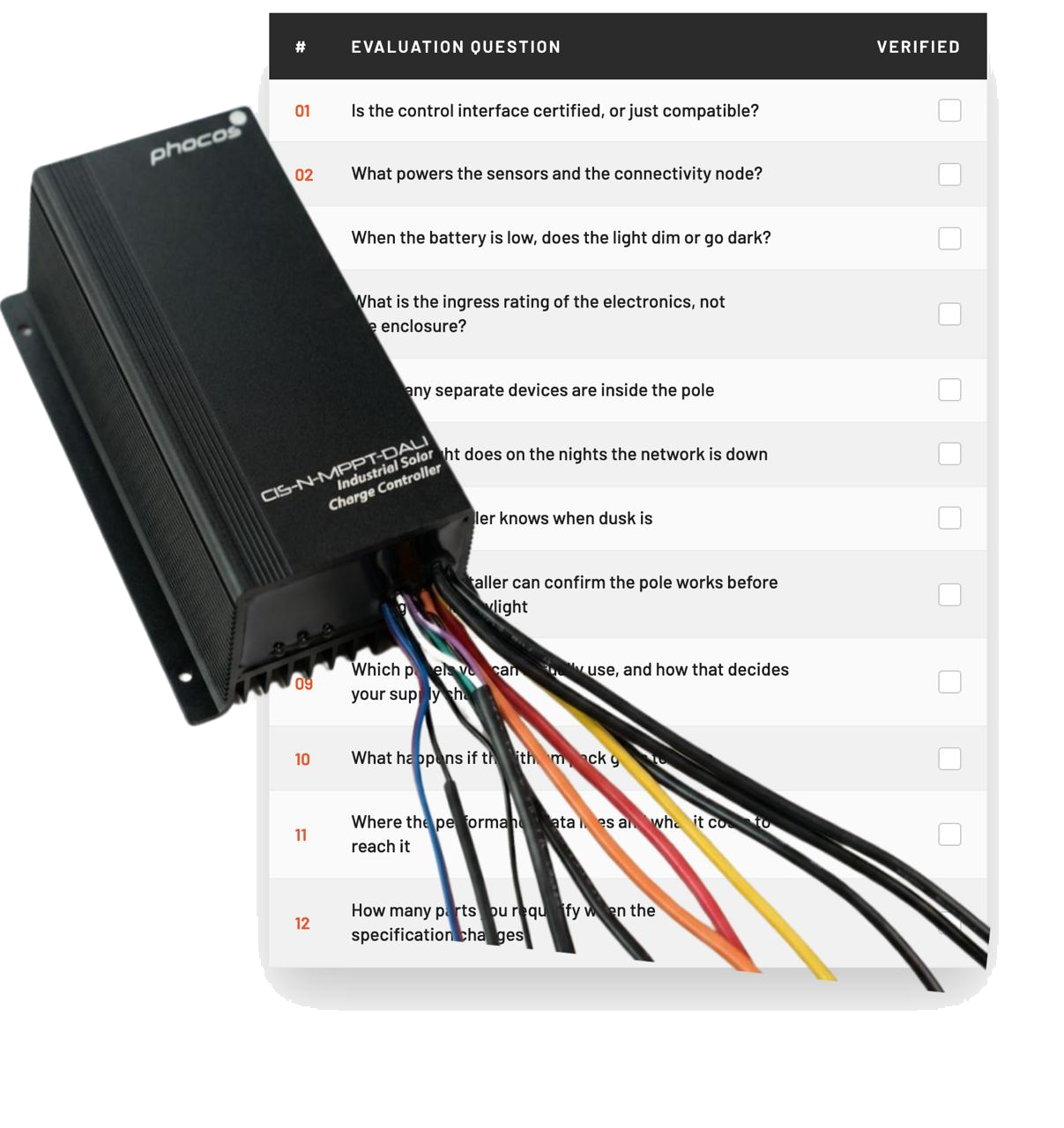
Twelve questions to ask before you specify your next solar street light. Written to be used on any supplier, including us.
One page, front and back. Vendor-neutral. Arrives in about thirty seconds.
The decision takes an afternoon. It lasts ten years.
The fixture gets chosen on lumens and optics. The panel gets chosen on watts. The battery gets chosen on capacity. Then someone picks the electronics that sit between them, usually quickly, usually on price, and usually from whatever was used last time.
That component decides whether the light can be dimmed, monitored, diagnosed, updated, or connected to anything at all. It decides what happens on a cloudy week in February. It decides whether somebody has to drive out in three years to find out why pole 68 is dark.
Most of these questions never come up in a supplier conversation, because most buyers do not know to ask them.
Four of the twelve, in full
Is The Control Interface Certified, Or Just Compatible?
DALI-compatible and D4i certified are different claims. Certification means the device was independently tested against the standard's requirements. Compatibility means somebody believes it will probably work. Ask which parts of the standard a supplier is certified against. If they cannot tell you, that is your answer.
When The Battery Is Low, Does The Light Dim Or Go Dark?
A conventional low-voltage disconnect is binary. It waits until the battery is nearly empty and then shuts the light off, usually around 3 a.m., usually in the middle of a bad weather week, and usually on the poles the city cares most about. A dimmer street does not generate a complaint call. A dark one does.
What Powers The Sensors And The Connectivity Node?
The control bus needs power. So does the motion sensor, the daylight sensor, and the wireless node. That power has to come from somewhere, and under the D4i standard the integrated supply that provides it is optional, which is why most drivers skip it. Without it, every connected pole in the project carries its own separate power supply.
What Is The Ingress Rating Of The Electronics, Not The Enclosure?
These are different numbers and they get conflated constantly. A controller rated IP65 inside a separately purchased box is a system that depends on a gasket, a gland, and an installer's care on a wet Tuesday. Ask for the submersion depth and duration rather than just the number.
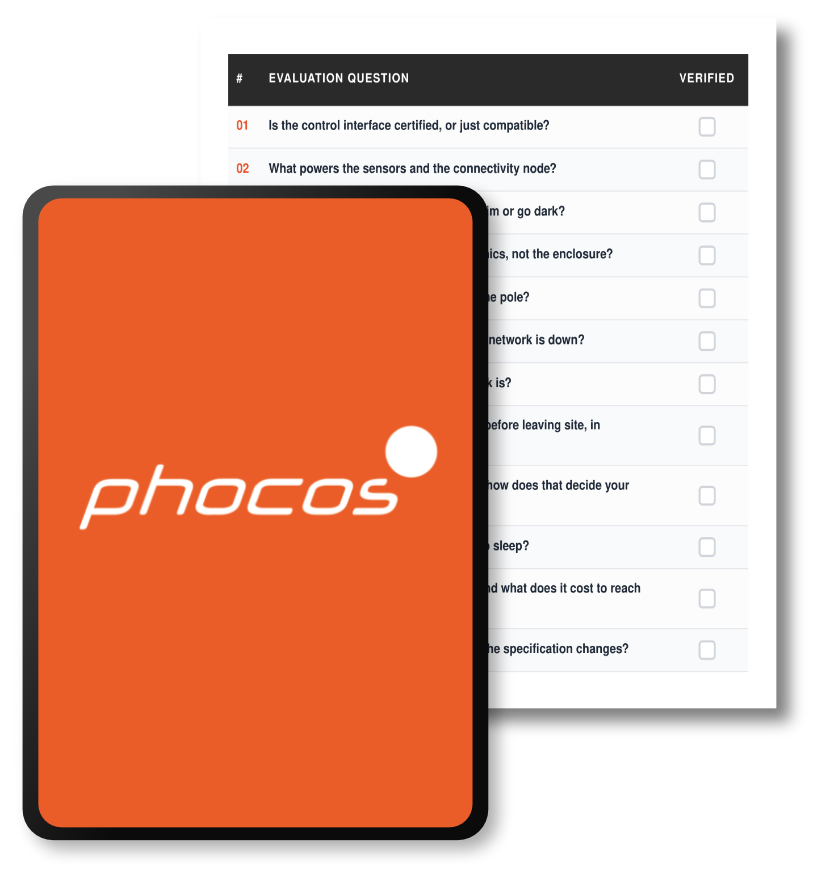
The other eight
How many separate devices are inside the pole
What the light does on the nights the network is down
How the controller knows when dusk is
Whether an installer can confirm the pole works before leaving site, in daylight
Which panels you can actually use, and how that decides your supply chain
What happens if the lithium pack goes to sleep
Where the performance data lives and what it costs to reach it
How many parts you requalify when the specification changes
Who Is this for?
Written for
OEMs building a solar street light product line that has to survive municipal specification review
Integrators and EPCs bidding smart-city, campus, port, and highway lighting
Distributors in municipal and infrastructure channels losing D4i-specified tenders
Engineers and specifiers writing requirements that have to hold up across a decade of maintenance
Probably not useful if
You are specifying a single pole for a private site. This is more scrutiny than you need.
You are researching residential or hobbyist solar lighting. Different product category, different economics.
Nothing in your market will ever ask for interoperability, and you are confident that will hold.
Written for
OEMs building a solar street light product line that has to survive municipal specification review
Integrators and EPCs bidding smart-city, campus, port, and highway lighting
Distributors in municipal and infrastructure channels losing D4i-specified tenders
Engineers and specifiers writing requirements that have to hold up across a decade of maintenance
Probably not useful if
You are specifying a single pole for a private site. This is more scrutiny than you need.
You are researching residential or hobbyist solar lighting. Different product category, different economics.
Nothing in your market will ever ask for interoperability, and you are confident that will hold.
Why a manufacturer wrote a vendor-neutral checklist
Because we would rather be specified on the merits than win by being the only supplier in the room.
Phocos has built off-grid solar charge controllers from Ulm, Germany since the company started, with operations now in the USA, India, and China. Our own DALI controller answers all twelve of these questions, and we are comfortable telling you that up front rather than pretending this document is neutral about who made it.
But the questions are the questions. Ask them of us, ask them of everyone else, and specify whoever answers them best. If your current architecture already answers all twelve, you do not need to talk to us at all.
You might be wondering...
Is This A Sales Pitch?
Phocos is named once, on the back page. The other four pages are questions you can put to any supplier.
What Happens To My Email Address?
You get the checklist, and three short emails over the following week from Youssef in our North America technical sales team. Each one covers one of the twelve questions in more depth. Unsubscribe on any of them and the emails stop. We do not sell or share your details.
Who Wrote It?
Our applications engineering and technical sales team, drawn from the questions customers actually ask on first calls and the failures they call us about afterwards.
Twelve questions. One page. Free.
Twelve questions. One page. Free.
Ask them of any supplier, including us. If your current architecture answers all twelve, that is genuinely good news and you can stop reading here.